2026-07-22 17:16:58
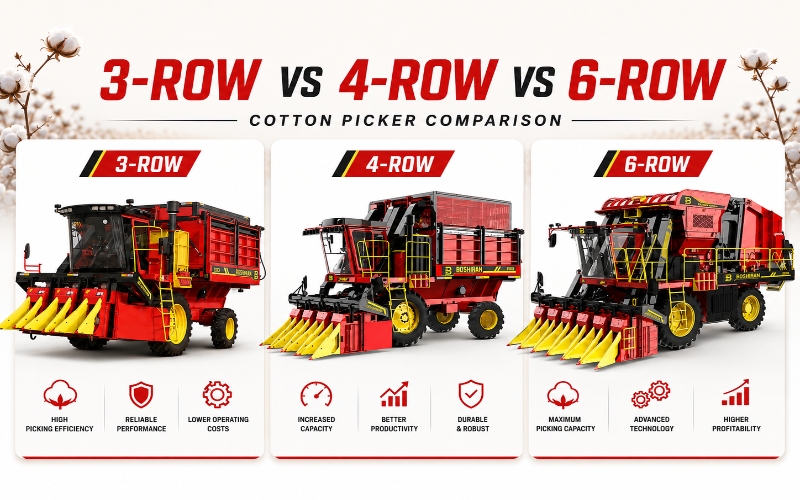
The main difference between a 3-row, 4-row, and 6-row cotton picker is harvesting capacity. A 3-row cotton picker is usually more flexible and cost-effective for small and medium cotton farms; a 4-row cotton picker offers a better balance between efficiency, price, and field adaptability; a 6-row cotton picker is designed for large-scale farms, long rows, high daily acreage, and professional harvesting operations. In simple terms, the wider the cotton picking machine, the more acres it can harvest per hour, but the higher the requirements for field size, operator skill, turning space, maintenance, transport, and investment. A 3-Row vs 4-Row vs 6-Row Cotton Picker comparison should not only look at row number. It should also consider row spacing, field shape, harvest window, cotton yield, budget, fuel use, spare parts, and after-sales support.
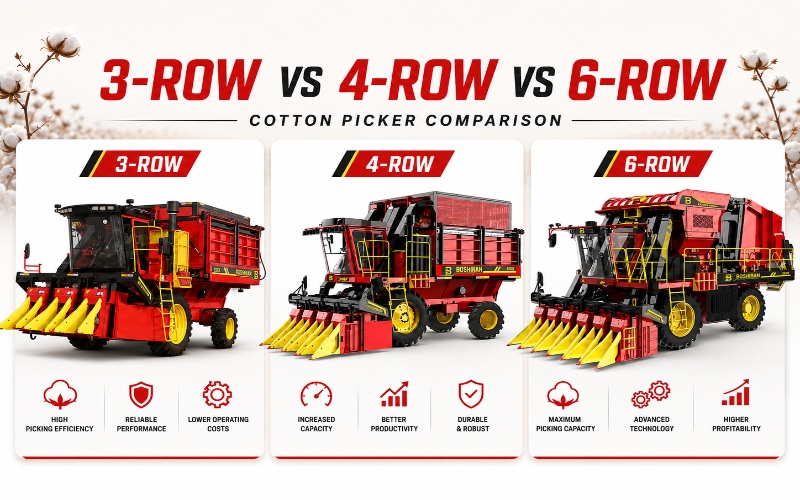
The row number of a cotton picker directly affects working width. A 3-row cotton picker harvests three cotton rows in one pass, a 4-row cotton picker harvests four rows in one pass, and a 6-row cotton picker harvests six rows in one pass. If row spacing, field speed, and field efficiency are the same, a 6-row cotton picker can theoretically cover about twice the width of a 3-row cotton picker.
Agricultural machinery capacity is commonly estimated by using operating width, travel speed, and field efficiency. Iowa State University Extension explains that theoretical field capacity depends on machine width and field speed, while effective field capacity is reduced by real field conditions such as turning, overlap, plugging, waiting, and adjustments. The effective field capacity formula is: width × speed × field efficiency ÷ 8.25.
This means a 3-Row vs 4-Row vs 6-Row Cotton Picker comparison is really a comparison of productivity, investment level, and field suitability. A larger mechanical cotton picker can reduce harvest time, but it may not always be the best choice if the farm has short rows, narrow field entrances, uneven terrain, small plots, or limited service capacity.
Quick Comparison: 3-Row vs 4-Row vs 6-Row Cotton Picker
| Item | 3-Row Cotton Picker | 4-Row Cotton Picker | 6-Row Cotton Picker |
|---|---|---|---|
| Main advantage | Flexible and lower investment | Balanced capacity and cost | Highest field capacity |
| Best for | Small to medium farms | Medium to large farms | Large farms and contractors |
| Field type | Smaller plots, shorter rows, irregular fields | Mixed field sizes, moderate row length | Large, flat, long-row fields |
| Investment level | Lower | Medium | Higher |
| Fuel and maintenance | Lower total consumption | Moderate | Higher total consumption, but lower cost per acre if fully used |
| Operator requirement | Easier to manage | Moderate | Higher skill required |
| Transport and turning | Easier | Manageable | Needs wider roads, headlands, and turning space |
| Harvest speed goal | Flexibility and affordability | Efficiency with control | Maximum daily acreage |
| Best buyer profile | Budget-sensitive grower | Growing farm or regional contractor | Large commercial grower or professional custom harvester |
Field capacity varies by row spacing, yield, ground speed, operator skill, unloading time, and crop condition. However, using a common 38-inch cotton row spacing and a 4.2 mph picking speed, a rough comparison can help buyers understand the difference.
| Machine Type | Approximate Working Width at 38-Inch Rows | Estimated Capacity at 75% Field Efficiency | Typical Practical Positioning |
|---|---|---|---|
| 3-row cotton picker | 9.5 ft | About 3.6 acres/hour | Flexible, lower-cost harvesting |
| 4-row cotton picker | 12.7 ft | About 4.8 acres/hour | Balanced harvesting efficiency |
| 6-row cotton picker | 19.0 ft | About 7.3 acres/hour | High-capacity commercial harvesting |
These estimates are consistent with Cotton Incorporated’s published harvesting capacity reference for six-row cotton harvest systems. Cotton Incorporated lists a six-row basket cotton picker at 4.2 mph, 75% picking field efficiency, and 7.3 acres per hour; it also lists a six-row round module-building picker at 4.2 mph, 83% picking field efficiency, and 8.0 acres per hour.
The key point is that a 6-row cotton picker is not automatically “better” than a 3-row cotton picker or 4-row cotton picker. The best cotton picking machine is the one that matches the farm’s land size, row spacing, harvest window, service ability, and investment plan.
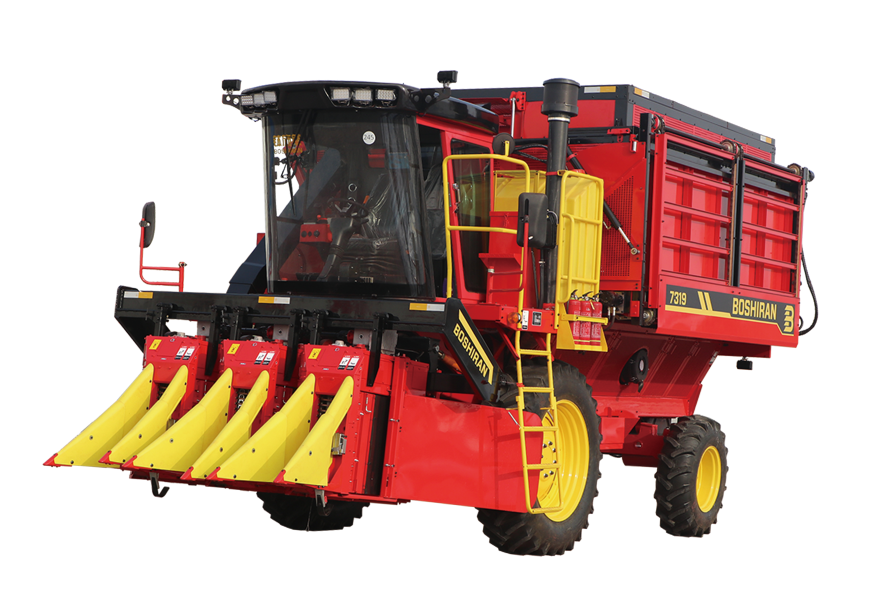
A 3-row cotton picker is a smaller mechanical cotton picker designed to harvest three rows of cotton at a time. It is often attractive for buyers who want mechanized cotton harvesting but do not need the capacity or cost level of a large 6-row cotton picker.
The biggest advantage of a 3-row cotton picker is flexibility. A 3-row cotton picker is easier to maneuver in smaller fields, easier to operate in irregular plots, and usually easier to transport than a larger cotton picking machine. For farms with fragmented land, shorter rows, smaller field entrances, or limited turning areas, a 3-row cotton picker may be more practical than a 6-row cotton picker.
A 3-row cotton picker can also be a good entry-level choice for farms shifting from manual cotton picking to mechanized cotton harvesting. In many cotton-producing regions, labor availability is becoming less stable, and a compact cotton picking machine can help farms reduce dependence on seasonal labor while keeping investment under control.
However, the limitation of a 3-row cotton picker is lower daily output. If the harvest window is short or the farm has a large planted area, a 3-row cotton picker may not finish the harvest quickly enough. Cotton quality can decline if harvesting is delayed after bolls open, and Cotton Incorporated notes that weathering, harvest delays, poor timing, high moisture, and inadequate picking capacity can reduce yield and lint quality.
A 3-row cotton picker is usually suitable when the farm has moderate acreage, smaller plots, limited roads, or a tighter budget. It is also suitable when the buyer wants easier maintenance, lower fuel use, and simpler field logistics.
Choose a 3-row cotton picker when:
Your cotton fields are small or scattered.
Your rows are shorter and turning space is limited.
Your annual cotton acreage does not justify a 6-row cotton picker.
Your budget is focused on practical mechanization rather than maximum capacity.
Your operators are still gaining experience with mechanical cotton picker operation.
You want easier transport between fields.
A 3-row cotton picker is not ideal when the farm needs to harvest very large acreage in a short period. If one machine must cover many hectares or acres quickly, a larger cotton picking machine may reduce the risk of harvest delay.
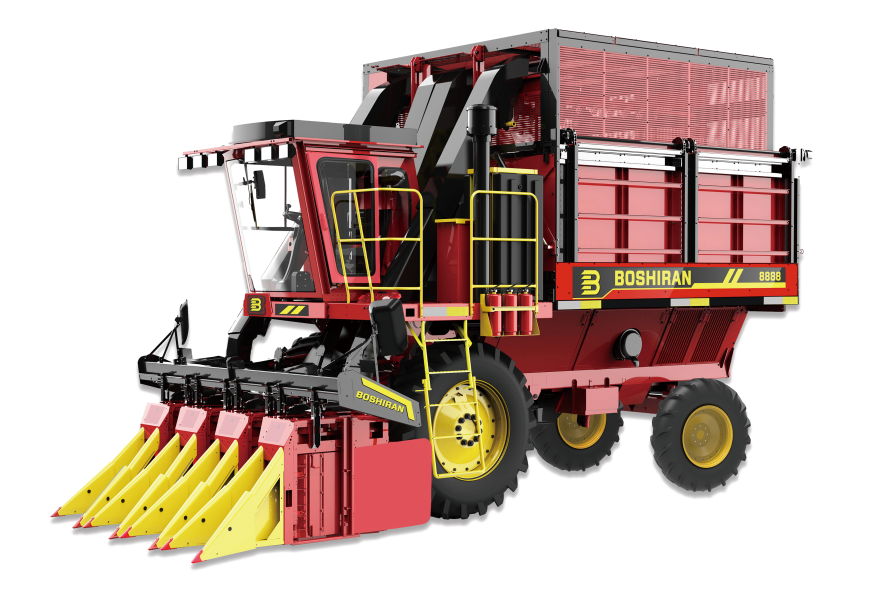
A 4-row cotton picker is often the middle choice between a 3-row cotton picker and a 6-row cotton picker. It provides more capacity than a 3-row cotton picker but is usually easier to manage than a 6-row cotton picker. For many buyers, the 4-row cotton picker is the most balanced option.
The 4-row cotton picker is useful for farms that have outgrown smaller machines but do not yet need the full capacity, cost, and field logistics of a 6-row cotton picker. A 4-row cotton picker can be especially practical in regions where farms have mixed field sizes: some larger fields, some smaller fields, and some roads or entrances that are not suitable for very wide equipment.
Major agricultural equipment manufacturers also position four-row and six-row machines differently. For example, Case IH lists Cotton Express models with 275 hp to 373 hp power, and its Cotton Express 420 uses a 275 hp engine while the Cotton Express 630 uses a 373 hp engine. This reflects the practical difference between mid-capacity and high-capacity cotton picking machine configurations.
A 4-row cotton picker is also easier to justify financially than a large 6-row cotton picker when the farm’s annual cotton acreage is not extremely high. If the machine is not used enough each season, the ownership cost per acre becomes too high. That is why a 4-row cotton picker can be a strong option for farms that need better efficiency but still want reasonable investment control.
A 4-row cotton picker is suitable for medium and growing cotton farms. It is also suitable for regional contractors who serve several farms but do not need the highest-capacity machine.
Choose a 4-row cotton picker when:
A 3-row cotton picker is too slow for your harvest window.
A 6-row cotton picker is too large or expensive for your farm.
Your fields are medium-sized and reasonably flat.
Your roads, field entrances, and headlands can support a wider cotton picking machine.
You want a balance between capacity, cost, and maintenance.
You need better efficiency but still want manageable operation.
For many buyers, the 4-row cotton picker is the safest middle choice. It improves daily acreage without creating the full transport, maintenance, and capital pressure of a 6-row cotton picker.
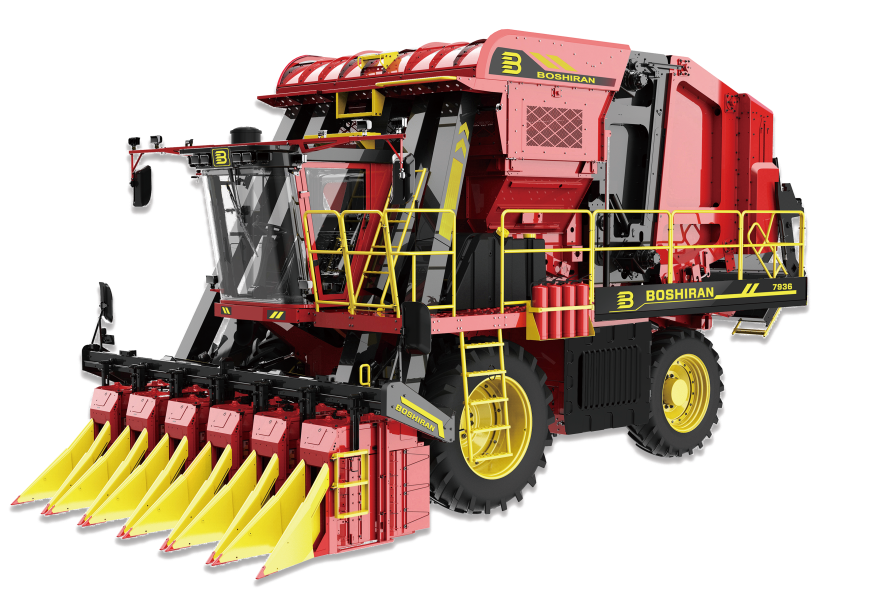
A 6-row cotton picker is a high-capacity mechanical cotton picker designed for large-scale cotton harvesting. It can harvest six rows in one pass, which gives it a much wider working width than a 3-row cotton picker or 4-row cotton picker.
The main advantage of a 6-row cotton picker is productivity. Cotton Incorporated’s data shows that typical six-row cotton harvest systems can reach 6.2 to 8.0 acres per hour depending on machine type, speed, field efficiency, and unloading or module-building system.
A 6-row cotton picker is especially suitable for large farms with long, straight rows and a short harvest window. In these conditions, the larger cotton picking machine can reduce the number of passes, reduce total harvest days, and improve the chance of completing harvest before weather causes quality loss.
However, a 6-row cotton picker also requires more support. It needs skilled operators, wider turning areas, stronger maintenance planning, reliable spare parts, and good after-sales service. Cotton Incorporated emphasizes that spindle pickers are complex, close-tolerance machines and that many producers rely on trained dealer or specialty shop technicians for major repairs and adjustments.
A 6-row cotton picker is the right choice when high daily capacity is more important than initial investment. It is usually best for large farms, commercial growers, and professional cotton harvesting contractors.
Choose a 6-row cotton picker when:
You have large cotton acreage.
Your fields are flat, open, and suitable for long-row operation.
Your harvest window is short and weather risk is high.
You need to reduce total harvest days.
You have trained operators and maintenance support.
You can keep the machine working enough hours each season.
You want lower cost per acre through high utilization.
A 6-row cotton picker may not be the best choice for small farms or fragmented fields. If the machine spends too much time turning, traveling, stopping, or waiting, the real field efficiency will be lower than expected. Iowa State University Extension notes that wider equipment can sometimes have slightly lower field efficiency because turns at headlands are longer, and wider equipment may even reduce acres per hour if travel speed must be slowed by field or power limitations.
Capacity is usually the first factor buyers compare. A 3-row cotton picker is the lowest-capacity option, a 4-row cotton picker is the medium-capacity option, and a 6-row cotton picker is the high-capacity option.
However, actual capacity is not only about row number. A 6-row cotton picker operating in long, flat fields may perform very efficiently. The same 6-row cotton picker in small, irregular fields may lose time in turning and transport. A 3-row cotton picker in small fields may work more smoothly than a 6-row cotton picker because it can enter, turn, and unload more easily.
The best way to estimate capacity is to calculate the acres that must be harvested and divide them by the available harvest days. For example, if a farm has 1,000 acres of cotton and only 15 suitable harvest days, the farm needs to harvest about 67 acres per day. If an 8-hour harvest day is realistic, the machine system needs to average more than 8 acres per hour. In this case, a 6-row cotton picker may be required. If the same farm has 30 harvest days, a 4-row cotton picker may be enough. If the farm has much less acreage, a 3-row cotton picker may be more economical.
Cost is another major difference. A 3-row cotton picker usually has the lowest purchase cost, the 4-row cotton picker sits in the middle, and the 6-row cotton picker has the highest investment level.
But the lowest purchase price does not always mean the lowest harvesting cost. If a 3-row cotton picker cannot finish the crop on time, delayed harvest may increase field loss and quality risk. On the other hand, if a 6-row cotton picker is used on too few acres, its ownership cost per acre may be too high.
Cotton Incorporated notes that harvesting expenses can account for about 16% of crop production costs in spindle-picked U.S. regions, with a reference harvesting cost of about $110 per acre. The same source also recommends spreading principal and interest costs over more acres and increasing field efficiency to reduce harvesting cost.
This is why cotton picker selection should be based on cost per acre rather than purchase price alone. A 6-row cotton picker can be cost-effective if it is fully utilized. A 4-row cotton picker can be more economical for medium farms. A 3-row cotton picker can be the best option when flexibility and lower investment matter more than maximum output.
Field suitability is often more important than machine size. A 6-row cotton picker needs enough space to operate efficiently. If fields are narrow, short, irregular, or surrounded by obstacles, the machine may lose much of its capacity advantage.
A 3-row cotton picker is better for small fields and complicated land conditions. A 4-row cotton picker works well in mixed conditions. A 6-row cotton picker performs best in large, well-prepared fields.
Row spacing must also match the cotton picking machine. Cotton Incorporated explains that older cotton production was standardized around 38- to 40-inch rows, while current picker row-unit designs can allow minimum row spacing of about 28–30 inches. This means buyers should confirm row spacing before choosing a 3-row cotton picker, 4-row cotton picker, or 6-row cotton picker.
A larger mechanical cotton picker has more row units, more spindles, more doffers, more bearings, more belts, more hydraulic demand, and more components to maintain. This does not mean a 6-row cotton picker is unreliable, but it does mean maintenance planning must be stronger.
Cotton Incorporated reports that spindle pickers can harvest 95–98% of cotton produced when properly operated, but some producers experience field harvest loss approaching 20% when adjustment or operation is poor. Common causes include row units not centered on the row, picking too soon, wrong crop maturity, incorrect spindle clearance, poor doffer adjustment, worn spindles, worn doffers, and losses in the handling system.
For a 3-row cotton picker, maintenance is usually simpler because there are fewer picking units. For a 4-row cotton picker, maintenance is moderate. For a 6-row cotton picker, maintenance is more demanding, but the higher capacity can justify the work if the machine covers enough acreage.
The best way to choose between a 3-row cotton picker, 4-row cotton picker, and 6-row cotton picker is to start from your real harvesting needs.
First, calculate your cotton acreage. If your acreage is small or medium, a 3-row cotton picker or 4-row cotton picker may be more economical. If your acreage is large, a 6-row cotton picker may be necessary.
Second, calculate your harvest window. If your region has a short harvesting period, frequent rain, or high weather risk, you may need a larger cotton picking machine to finish quickly.
Third, check your field layout. Long and straight fields support a 6-row cotton picker. Smaller or irregular fields may favor a 3-row cotton picker or 4-row cotton picker.
Fourth, check your budget. A larger mechanical cotton picker may reduce cost per acre only when it is fully used. If the machine is underused, a smaller cotton picking machine may provide a better return.
Fifth, check service support. A cotton picker is a precision harvesting machine. Spare parts, trained technicians, and operator training are essential for stable performance.
Q:Which is better, a 3-row or 4-row cotton picker?
A:A 4-row cotton picker is usually better if you need higher daily capacity and have medium-sized fields. A 3-row cotton picker is better if your fields are smaller, your budget is lower, or you need easier maneuverability.
Q:Is a 6-row cotton picker always the best choice?
A:No. A 6-row cotton picker is best for large, flat, long-row fields. If the field is small or irregular, a 6-row cotton picker may lose efficiency because of turning, transport, and unloading delays.
Q:How many acres can a 6-row cotton picker harvest per hour?
A:Cotton Incorporated lists typical six-row cotton harvest systems at about 6.2 to 8.0 acres per hour, depending on whether the machine is an older six-row basket picker, a six-row basket picker, or a six-row round module-building picker.
Q:Is a 3-row cotton picker suitable for commercial farms?
A:A 3-row cotton picker can be suitable for smaller commercial farms, fragmented fields, or farms entering mechanized cotton harvesting. For very large commercial farms, a 4-row cotton picker or 6-row cotton picker is usually more efficient.
Q:What is the biggest mistake when choosing a cotton picking machine?
A:The biggest mistake is choosing only by row number or price. Buyers should compare acreage, row spacing, harvest days, field shape, operator skill, service support, and long-term cost per acre.
Q:Which cotton picker is best for dealers?
A:For dealers, the best model depends on the local customer base. If customers are mainly small and medium farms, a 3-row cotton picker or 4-row cotton picker may be easier to sell. If customers are large-scale growers or contractors, a 6-row cotton picker may have stronger demand.
A 3-Row vs 4-Row vs 6-Row Cotton Picker comparison is ultimately a selection decision between flexibility, balance, and maximum capacity. A 3-row cotton picker is practical for smaller farms, lower budgets, and irregular field conditions. A 4-row cotton picker offers a strong balance between harvesting efficiency and investment control. A 6-row cotton picker is the best option for large farms, long rows, short harvest windows, and high-capacity commercial operations.
The right mechanical cotton picker is not always the largest machine. The right cotton picking machine is the one that can harvest your cotton on time, match your row spacing, fit your field conditions, control your cost per acre, and receive reliable parts and service support. For buyers comparing a 3-row cotton picker, 4-row cotton picker, and 6-row cotton picker, the best choice should be based on real field conditions and long-term operating value, not only machine size.
Related Products
Discover Our Comprehensive Range of Large Agricultural Machinery Categories
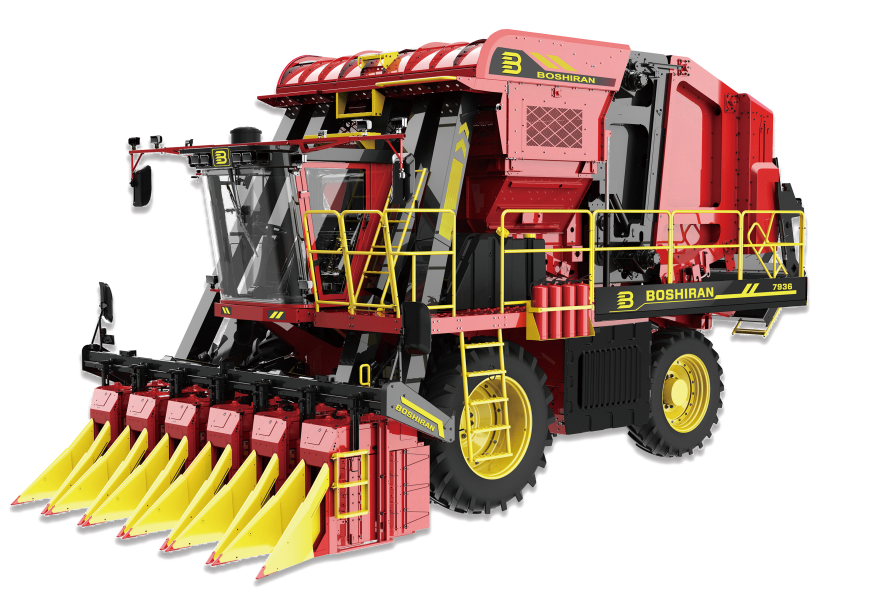
Boshiran 7936(4MZD-6C/6D) Self Propelled Cotton Picker with Baler
The Boshiran 6-row cotton picker is designed spe...
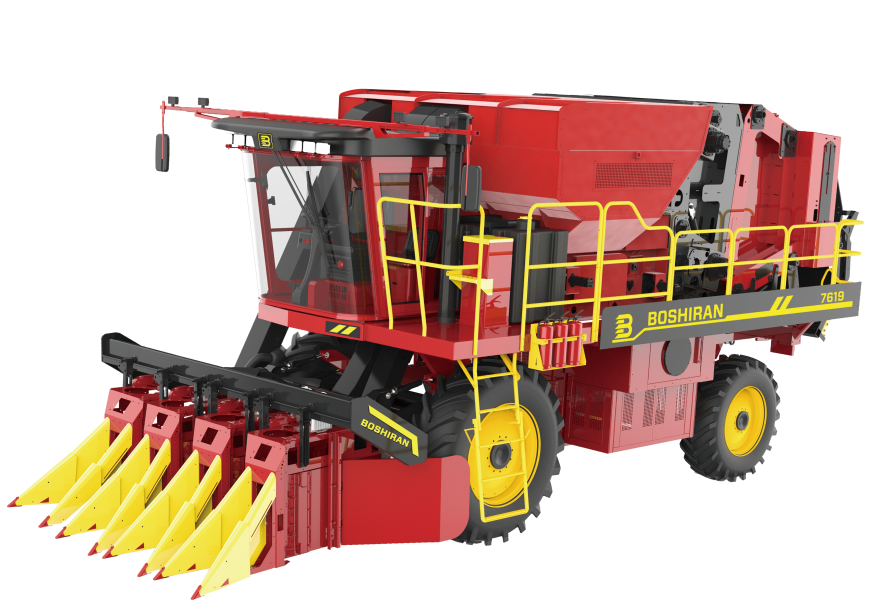
Boshiran 7493 (4MZD-4A) Self Propelled Cotton Picker with Baler
Boshiran independently develops and manufactures...
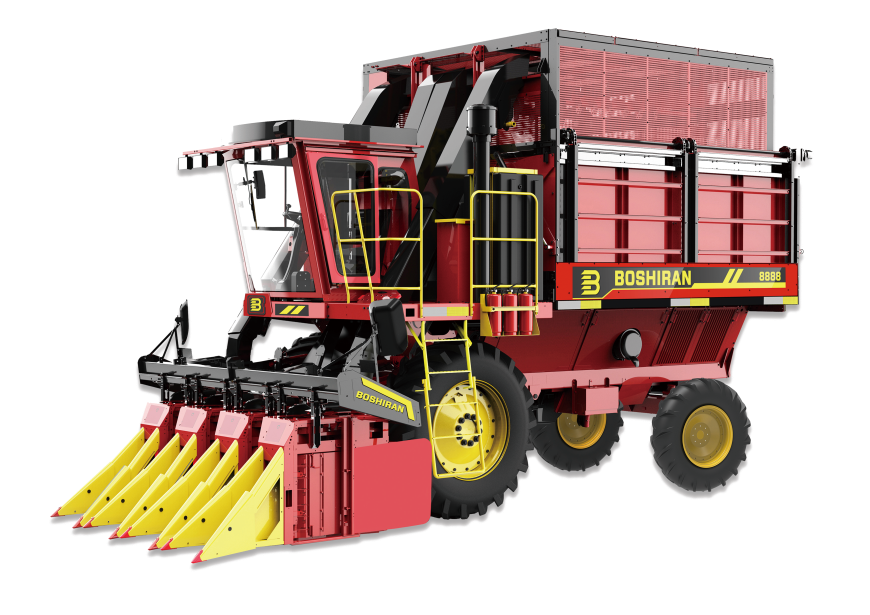
Bosiran 4MZ-4A Self Propelled Cotton Picker
The Boshiran Small Intelligent 4-Row Cotton Pick...
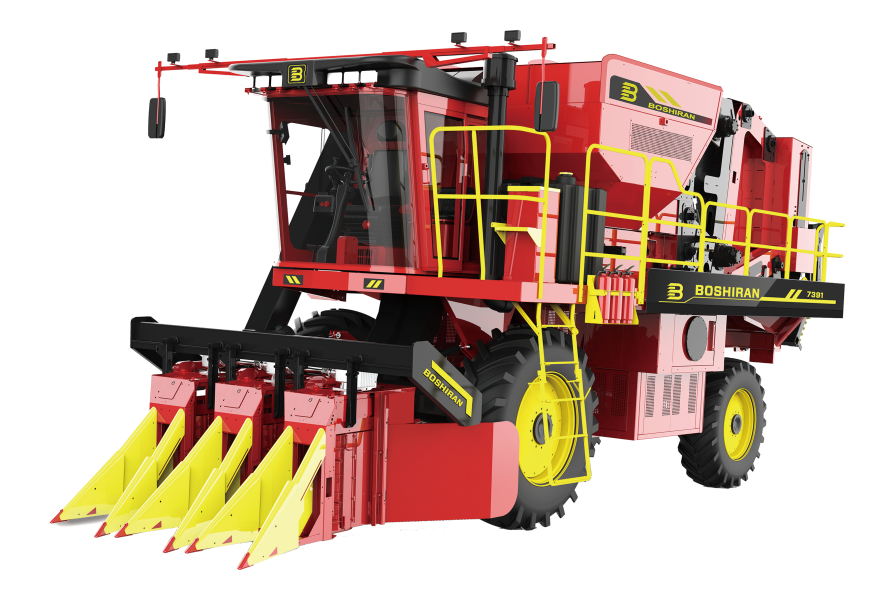
Bosiran 7391 (4MZD-3A) Self Propelled Cotton Picker with Baler
Boshiran 3-Row Baling Cotton Harvester combines ...
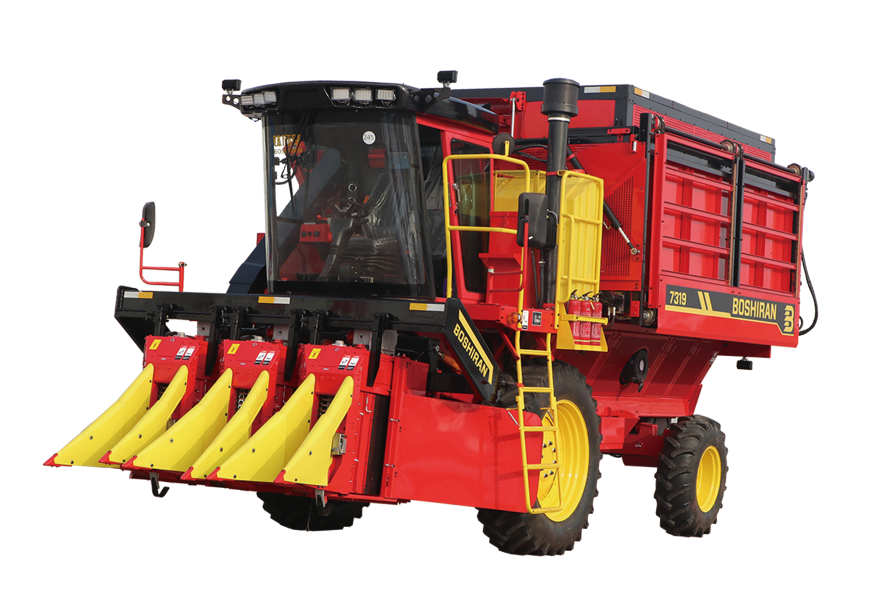
Boshiran 4MZ-3B Self Propelled Cotton Picker
After years of technical accumulation,Boshiran 3...
3-Row vs 4-Row vs 6-Row Cotton Picker: How to Choose the Right Machine
2026-07-22
Compare 3-row, 4-row, and 6-row cotton pickers by field capacity, farm size, row spacing, cost, maneuverability, maintenance, and cotton harvesting efficiency.
2025-09-10
As the 2025 cotton picking season is around the corner, to ensure the cotton picking work proceeds efficiently and smoothly, leaders of Boshiran's Uzbekistan branch, together with after-sales technica
2025-04-27
Recently, the reporter walked into the after-sales workshop, and rows of cotton pickers returned to the factory for maintenance and maintenance were neatly displayed in the workshop. The technicians s
2025-04-19
On August 22, in the assembly workshop of Wusu Factory, workers were working overtime to assemble four-row box-type cotton pickers, six-row baling cotton pickers and two-row box-type machines. In orde